
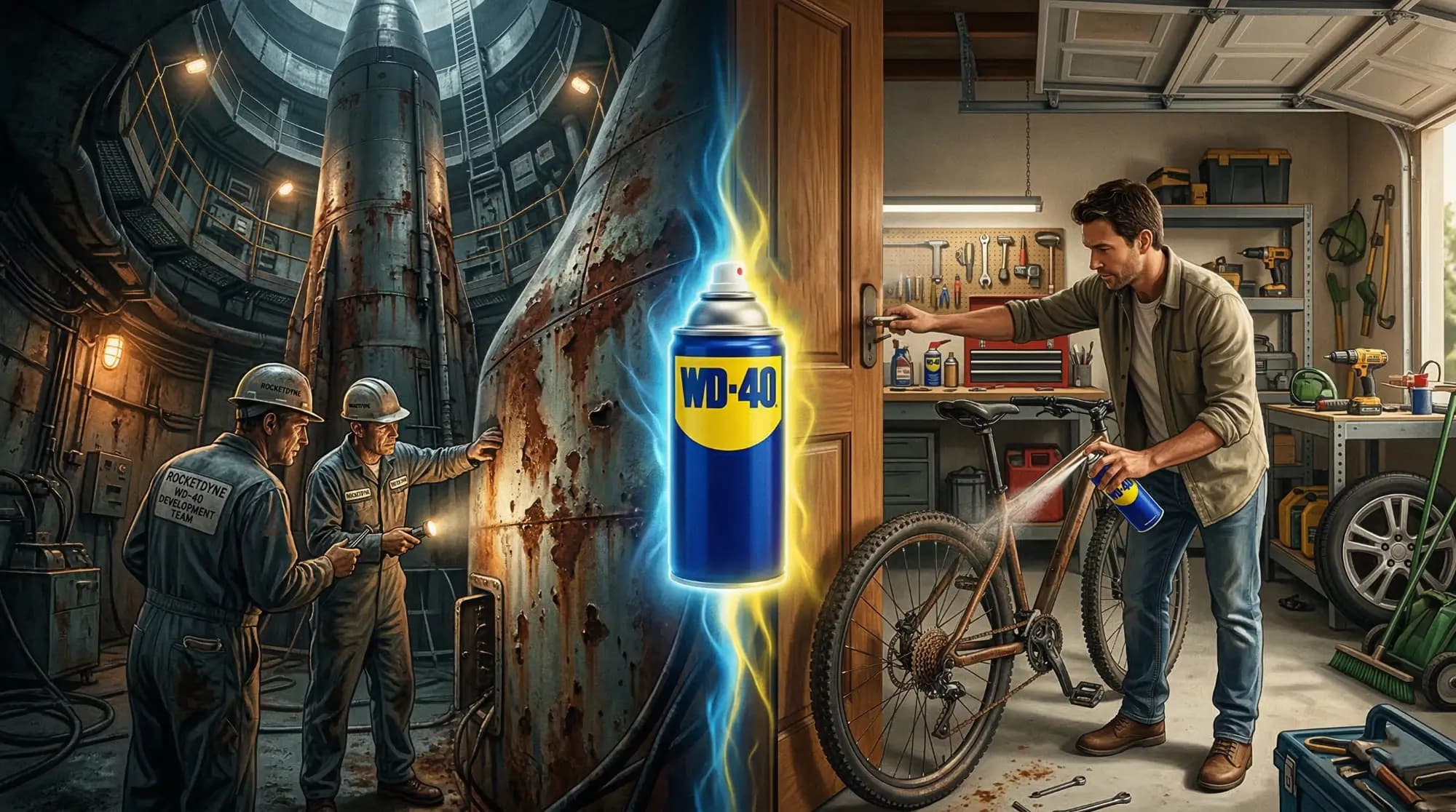
WD-40: From Missile Corrosion to Market Expansion

A chemist named Ivor Norman Lawson at the Rocket Chemical Company was tasked with solving it. He experimented relentlessly. Thirty-nine formulas failed. Some were too volatile. Others damaged the metal they were meant to protect.
On the 40th attempt, he got it right. Water Displacement. Formula 40. WD-40.
At that moment, it was simply a functional engineering breakthrough. No brand architecture. No go-to-market strategy. No ambition to enter consumer life.
If things had stayed that way, WD-40 might have remained an industrial footnote. But the market had other ideas.
Table of Contents
- How Did WD-40 Scale Without Aggressive Advertising?
- What Happens When Customers Become Your Creative Director?
- What Happens When Customers Define Your Product for You?
- Did WD-40 Create a Blue Ocean — or Something More Durable?
- What Is Elastic Positioning — and Is It Right for Your Brand?
- Three Signs You’re Defining Your Brand Too Tightly
- Frequently Asked Questions About Elastic Positioning
- The One Question to Ask Before Your Next Campaign
How Did WD-40 Scale Without Aggressive Advertising?
Most growth marketers assume scale requires amplification — paid channels, distribution leverage, aggressive messaging.
WD-40 scaled differently.
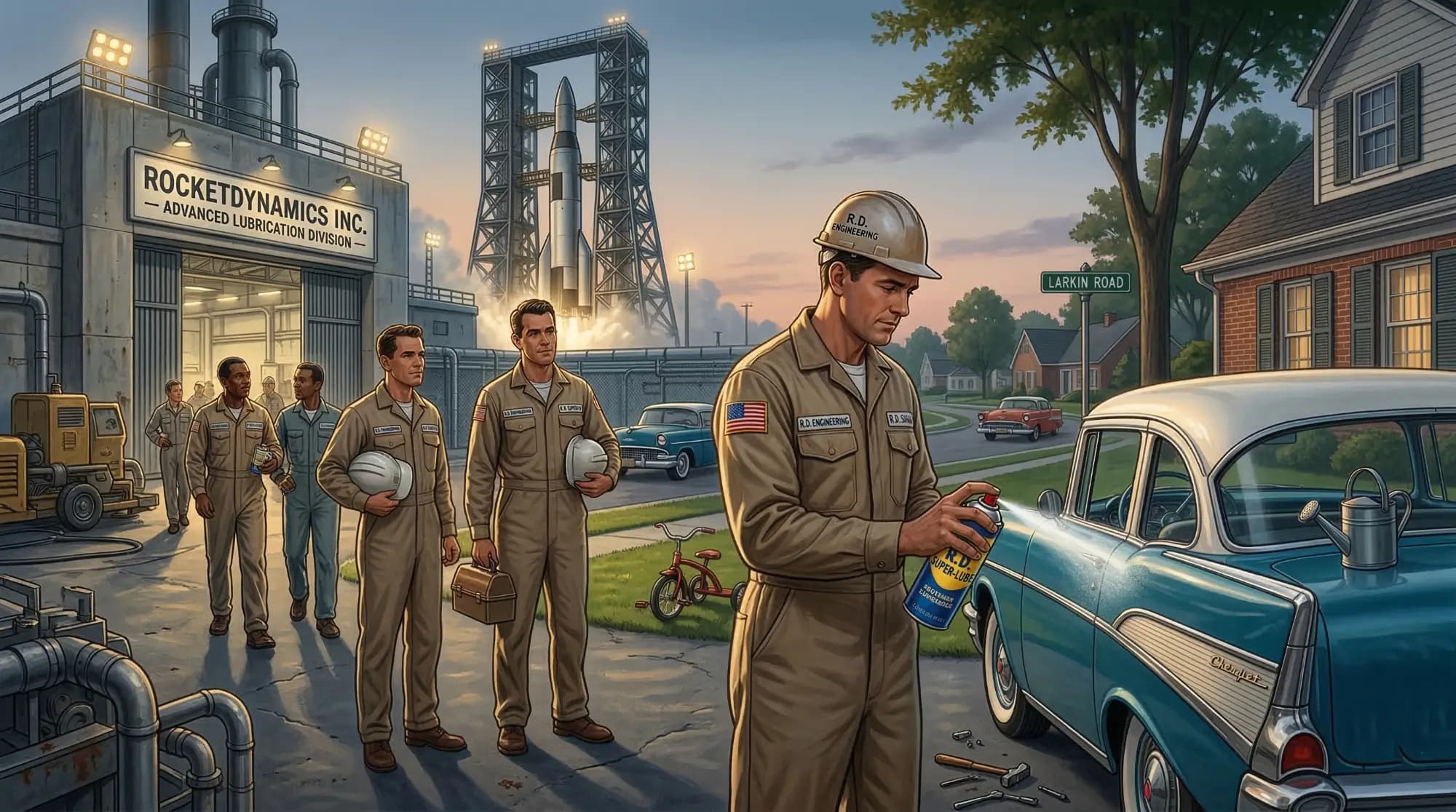
Employees began taking cans home. Not as part of a consumer strategy — but because the formula worked.
They used it on squeaky hinges, stuck bolts, and jammed tools. Neighbors borrowed it. Hardware stores started requesting small shipments. The product moved quietly from missile silos into garages.
No campaign drove this shift. Performance did. That’s an important distinction.
Most brands attempt expansion through messaging. WD-40 expanded through application. The market discovered uses faster than the company could define them. And once discovery began, it compounded.
This is the first inflection point in the story:
The moment a product escapes its original category because its usefulness travels.
What Happens When Customers Become Your Creative Director?
When WD-40 eventually reached retail shelves, the company faced a decision that would define its trajectory.

It could have narrowed its identity:
Rust prevention spray. Industrial lubricant. Garage maintenance solution.
Instead, it printed three simple words on the can:
Multi-Use Product
That phrase is deceptively disciplined. It doesn’t over-promise. It doesn’t restrict use. It doesn’t anchor the brand to a single category. It leaves interpretive space.
Over time, customers documented more than 2,000 uses. In some years, the company received over 100,000 suggestions. From removing gum in hair to protecting tools in winter weather, the brand became a problem-solving companion rather than a single-function tool.
Today, WD-40 is sold in more than 187 countries, sits in roughly 78% of U.S. households, and generates over $590 million annually.
That growth wasn’t fueled by constant repositioning. It was fueled by participatory discovery.
What Happens When Customers Define Your Product for You?
There’s risk in this.
Letting customers shape your use cases means surrendering some control. Classical positioning theory argues that brands should “own a word” in the customer’s mind.
Volvo owns safety. FedEx owns overnight. Clear. Tight. Controlled.
WD-40 didn’t own a word. It owned a situation.
If it moves and shouldn’t, use duct tape. If it doesn’t move and should, use WD-40. That’s not vertical positioning. That’s horizontal authority.
For growth teams, this raises a real strategic question:
When does narrowing improve clarity — and when does it compress opportunity?
At Heigh10, we often see brands unintentionally shrinking their future market by defining themselves too tightly around current features. WD-40 avoided that trap.
Did WD-40 Create a Blue Ocean — or Something More Durable?
At first glance, WD-40 resembles Blue Ocean Strategy — creating uncontested market space instead of competing inside crowded waters.
But there’s nuance.
Blue Ocean Strategy often involves deliberate category reconstruction: redefining buyer groups, eliminating industry factors, and reshaping value curves.

WD-40 didn’t engineer a new category. It allowed its category to stretch. Instead of competing within “rust spray,” it became a situational solution across contexts.
That’s not classic Blue Ocean. It’s category elasticity. And elasticity compounds.
What Is Elastic Positioning — and Is It Right for Your Brand?
At Heigh10, we describe WD-40’s approach as Elastic Positioning.
Elastic Positioning is when a brand maintains strong core value while leaving strategic space for customers to expand perceived use cases over time.
It is not vagueness. It is disciplined openness.
The product must work. The value must be undeniable. Without that foundation, elasticity collapses into confusion.
WD-40 succeeded because its formula was reliable. Reliability created trust. Trust encouraged experimentation. Experimentation expanded TAM — without the brand needing to reinvent itself every few years.
Elastic Positioning is powerful. But it’s not for every brand.
Three Signs You’re Defining Your Brand Too Tightly
For growth marketers, here’s the practical layer.
- Your positioning describes features, not outcomes.
- Adjacent use cases exist — but your messaging discourages them.
- Your TAM feels capped even though demand signals suggest otherwise.
If any of these feel familiar, your positioning may be compressing growth rather than enabling it. Elastic Positioning doesn’t replace segmentation.
It prevents premature compression.
Frequently Asked Questions About Elastic Positioning
Was WD-40 intentionally positioned as a multi-use product?
Yes — but as a strategic restraint, not aggressive positioning. The label “Multi-Use Product” avoided narrowing the brand too early.
How does this differ from Blue Ocean Strategy?
Blue Ocean is often a deliberate market reconstruction. Elastic Positioning allows markets to stretch organically through interpretive use.
Does Elastic Positioning work for startups?
Only if product-market fit is strong, an Elasticity Positioning amplifies value — it does not create it.
Can this reduce acquisition costs?
In some cases, yes. When customers discover additional use cases organically, expansion can occur without proportional increases in paid acquisition.
The One Question to Ask Before Your Next Campaign
Before tightening your messaging further, ask: Are we clarifying our value — or shrinking our horizon?

WD-40 began as a corrosion solution for nuclear missiles.
It became a household standard because it worked — and because it resisted the urge to define itself too tightly.
For growth marketers, the lesson is simple:
Positioning doesn’t just clarify value. It determines the size of your market.
What’s a brand you’ve seen grow because it left room for interpretation instead of shrinking its category?
I’d love to hear your examples.
